AI Software · Business Automation · Pulse Software Solutions
From chatbots that never sleep to algorithms that forecast demand, AI is quietly absorbing the repetitive work that used to drain teams. Here is how automation is reshaping six everyday business functions, and what it means for your operations.
Jump To Section
Artificial intelligence has stepped out of the research lab and into the day-to-day operations of nearly every industry. The tasks AI handles today were once time-consuming, error-prone, and resource-intensive: answering routine questions, cleaning spreadsheets, screening resumes, forecasting demand. By taking these off the plate of human teams, AI is freeing American businesses to focus on the strategic, high-value work that actually moves the needle.
The real story of AI is not science fiction. It is the quiet automation of repetitive work that lets your best people do their best thinking.
01 · Customer Support
Chatbots and virtual assistants that handle the front line
One of the most visible applications of AI is in customer support. Businesses use AI-powered chatbots and virtual assistants to handle the first wave of customer inquiries, respond instantly to frequently asked questions, resolve common issues, and offer personalized recommendations based on customer data.
AI systems operate around the clock, reducing wait times and providing immediate assistance, which lifts the overall customer experience.
By automating routine queries, AI keeps responses consistent and accurate across every interaction.
Automating support tasks reduces the need for large frontline teams while keeping service quality high.
Routine work goes to the bot, complex issues go to humans, and your team spends their time on conversations that actually need them.
02 · Data Analysis
Turning oceans of data into decisions you can act on
Every business now generates more data than it can manually process. AI software, including machine learning algorithms, is changing how teams analyze that information. Data cleaning, trend identification, and predictive modeling can all be handled through automation, and the results land in front of decision-makers in minutes rather than weeks.
AI processes large volumes of data in real time, giving leaders insights when those insights are still actionable.
AI tools surface patterns and correlations that human analysts miss, leading to sharper conclusions.
As data volume climbs, AI solutions scale up without a drop in performance or a hiring spree.
Models trained on your history forecast what is coming next, not just describe what already happened.
03 · HR & Recruitment
From resume pile to shortlist in a fraction of the time
AI has made real progress inside HR, especially in recruitment. AI-driven hiring software automates repetitive work like resume screening, candidate matching, and even initial interview rounds. These tools can sift through thousands of resumes in the time it takes a recruiter to grab coffee, surfacing the strongest matches based on the job description and historical hiring data.
Recruiters focus on interviewing and relationship-building instead of screening stacks of resumes.
Well-designed AI tools apply criteria evenly, helping reduce unconscious bias and supporting more diverse hiring.
Analysis across huge datasets identifies candidates whose background actually aligns with what the role demands.
Better matches early translate into higher retention later, lowering long-term hiring costs.
04 · Supply Chain & Inventory
Smarter inventory, faster fulfillment, fewer surprises
In logistics and supply chain management, AI is automating inventory management, order fulfillment, and demand forecasting. Machine learning algorithms predict trends, optimize stock levels, and automate reorder cycles so warehouses are neither overstuffed nor caught empty.
Optimized inventory prevents both overstocking and stockouts, which cuts cost in two directions at once.
AI streamlines order processing and shipment tracking, reducing manual touches and speeding up delivery.
Past trends combined with external signals produce demand predictions you can actually plan around.
When a disruption hits, AI-driven supply chains adapt and reroute before the impact reaches your customers.
05 · Marketing
Personalization at scale without a bigger team
AI is reshaping digital marketing by automating customer segmentation, content personalization, and ad targeting. Machine learning models analyze behavior and preferences, then deliver personalized emails, recommend products, and tune ad campaigns in real time.
Tailor content and offers to individual customers across your entire audience without manual segmentation.
Better targeting lifts conversion rates and stretches every marketing dollar further.
Email scheduling, social posting, and ad bidding all run on autopilot, freeing marketers for strategic work.
Campaigns adjust themselves based on what is working right now, not what worked last quarter.
06 · Healthcare
More time for patients, less time on paperwork
AI is also reshaping healthcare by automating medical image analysis, patient data entry, and even preliminary diagnostic work. AI-powered tools can examine medical images to flag conditions like tumors and predict patient outcomes using historical data, all while administrative work runs in the background.
AI can flag medical conditions with high accuracy, acting as a second set of eyes for clinical teams.
Automating administrative chores and routine data analysis gives clinicians more time with patients.
Automated data entry and diagnostic support help reduce facility costs and improve access to care.
Earlier detection and faster triage translate into measurable gains in patient outcomes across the system.
In Practice
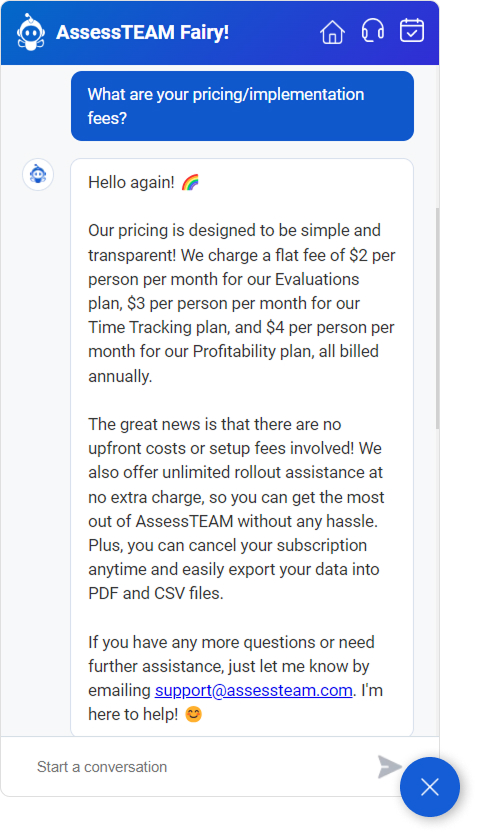
How AssessTEAM automated customer support with AI
AssessTEAM, a leading performance management platform, deployed AI to optimize operations and improve efficiency. The standout move in their transformation was an AI-powered chatbot that took routine support work off the human team and gave clients faster answers in return.
The numbers backed it up. The chatbot saved over 100 man-hours per week that had previously gone to repetitive inquiries. Around-the-clock coverage shortened wait times and lifted customer satisfaction. A leaner support footprint cut operating cost without lowering service quality, and consistent AI responses raised the accuracy of routine interactions.
Final Thoughts
Efficiency, productivity, and a clear competitive edge
AI software is reshaping industries by automating repetitive tasks, optimizing operations, and lifting service quality. Whether the goal is to automate customer service, streamline a supply chain, or rethink HR, the benefits land in the same place: higher efficiency, higher productivity, and lower operational cost. As the technology keeps maturing, its ability to absorb everyday work across industries will only grow, and the businesses that adopt early will have a real edge in an increasingly digital economy.
With AI software development solutions, your business can hand the mundane work to intelligent systems and redirect your people toward innovation and growth. Pulse Software Solutions sits at the front of this shift, building tailored AI solutions that automate processes and help American businesses unlock their full potential.
Ready to put AI to work on your everyday tasks?
Tell us which processes are eating your team’s time. We will map out an AI automation plan tailored to your operations and your goals.