AI Chatbots · DOT Compliance · Pulse Software Solutions
How a 10‑year‑old compliance platform replaced ticket backlogs with instant, cited, audit‑ready answers, without adding a single support hire.
Jump To Section
Meet the Client
A decade‑proven compliance partner for fleets and contractors
A U.S. based compliance services provider that helps contractors and fleet operators stay safe, reduce liability, and remain audit‑ready. Their platform streamlines driver onboarding, document tracking, and regulatory workflows. After 10+ years in market, serving fleets of every size, the product was working. The support model around it was not.
The Need
Support was getting crushed by the same questions, on repeat
Customers were asking the same rules and workflow questions over and over. Each one required a human agent to look it up, write it out, and hope they got it right. The pattern showed up in four ways:
Long wait times on common, easily‑answered questions
Support load rising faster than revenue
Almost no visibility into what users were actually stuck on
Inconsistent answers depending on which agent picked up the ticket
The brief was simple to state and hard to deliver: instant, accurate, auditable answers at scale, without adding headcount.
The Solution
An AI chatbot wired directly into the platform and its knowledge sources
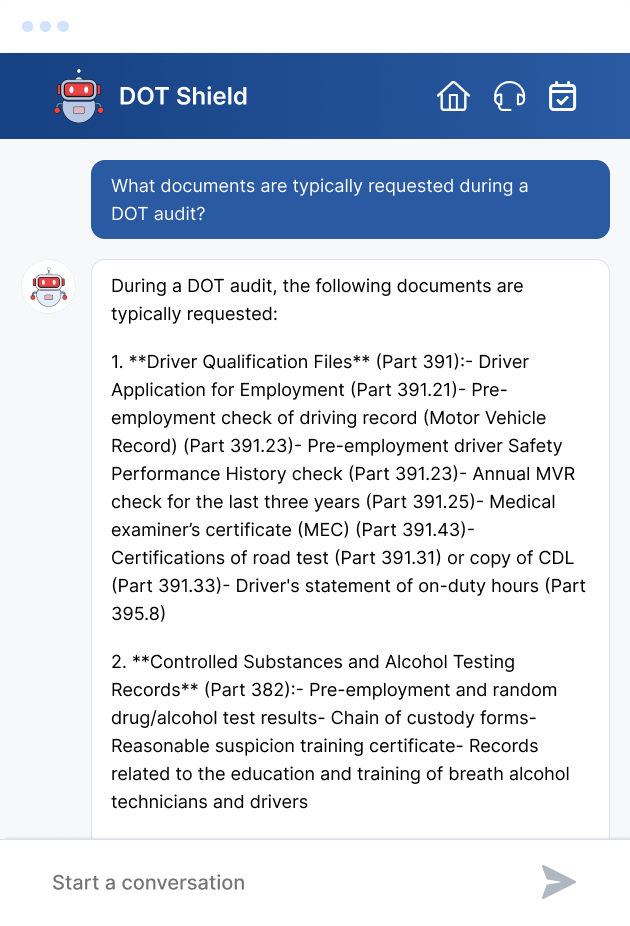
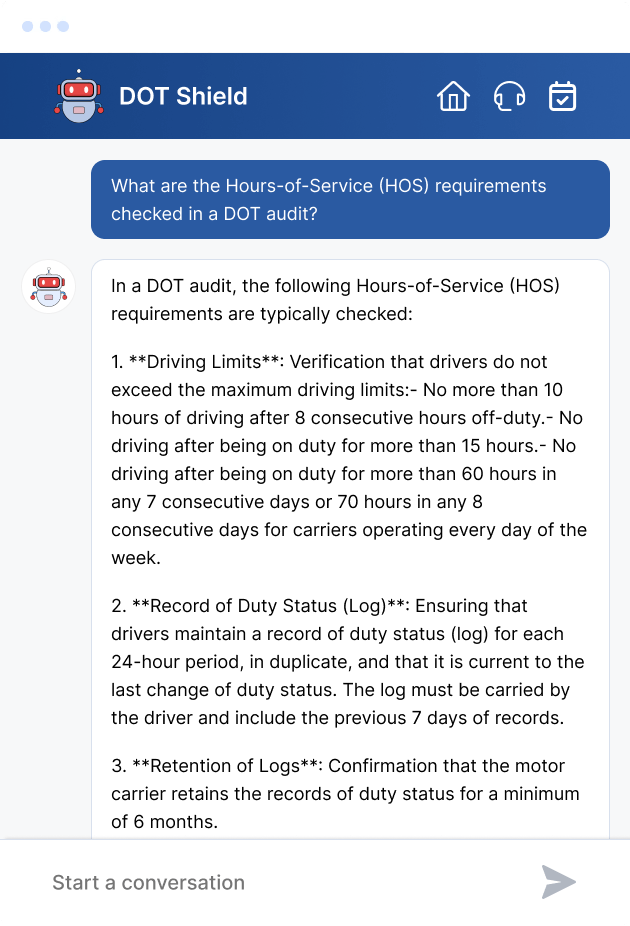
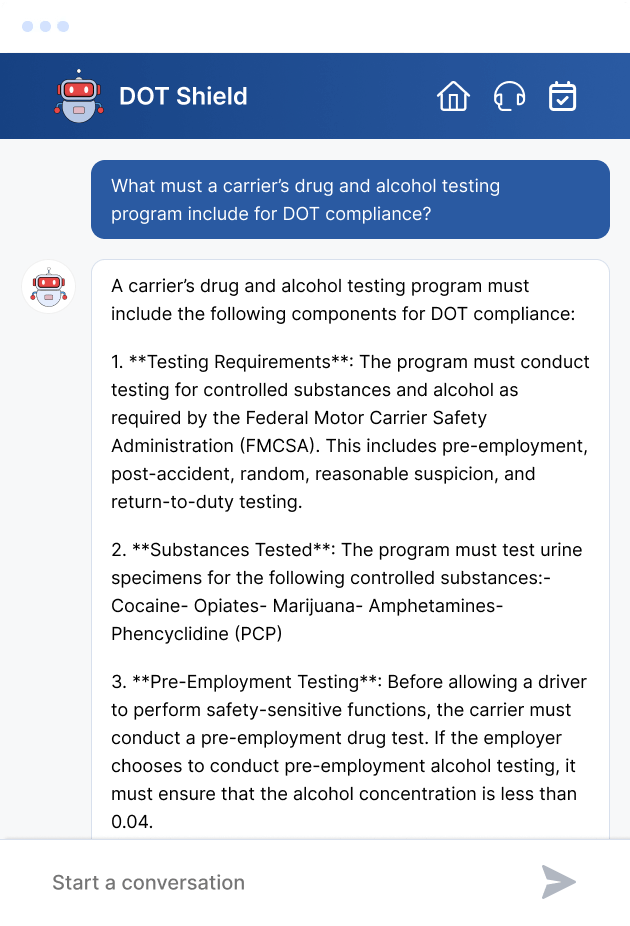
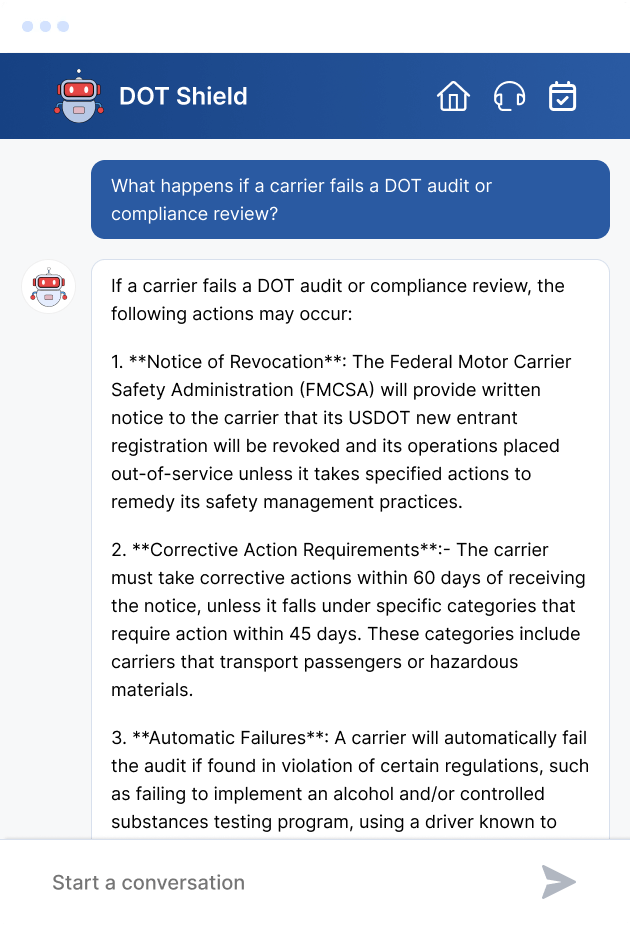
Pulse Software Solutions built and deployed an AI‑powered chatbot that lives inside the client’s product. It pulls account context securely, reasons across regulatory text and internal documentation, and returns answers with the exact source sections used. Here is what makes it work day after day.
Pulls just‑enough context to answer account‑specific questions securely, with field‑level filtering on sensitive data.
OpenAI handles natural language; Pinecone stores policies, SOPs, release notes, and FAQs as vectors for fast, traceable answers.
Trained on DOT, OSHA, and EHS references so users can ask in plain English and get precise guidance with citations.
Handles multi‑factor questions across 49 CFR Parts 382, 383, 387, 390 to 399 and HazMat 171 to 180. Returns a clear answer plus source sections. Not legal advice.
Conversation logs surface knowledge gaps. Content and prompts are iteratively improved to raise accuracy quarter over quarter.
PII masking, role‑based access, and auditable logs. Customer data is not used to train public models. Always on, 24/7.
Complex DOT Compliance Q&A
Five real scenarios the bot resolves with citations
These are not toy examples. They are the kind of questions that used to land on a senior agent’s desk and stay there for hours. Here is how the bot handles them, end to end.
Hours of Service
Asked: A driver started short‑haul (150 air miles), then a breakdown pushed him outside the radius and he invoked the 16‑hour exception. Later he hit adverse driving. Do we need full ELD RODS for the whole day, and how do we annotate personal conveyance back to the terminal?
Delivered: Stepwise applicability, short‑haul converting to RODS once limits are exceeded, constraints on the 16‑hour exception, what adverse driving can and cannot extend, ELD annotation guidance, with citations to 49 CFR Part 395.
Drug & Alcohol / Clearinghouse
Asked: A pre‑employment test came back positive for a CDL driver. Map the full Return‑to‑Duty path under Parts 40 and 382: SAP evaluation, RTD test, follow‑up plan, employer Clearinghouse reporting, and record retention. What may we disclose to a prospective employer?
Delivered: A sequenced checklist, roles (employer vs. SAP vs. MRO), Clearinghouse events, confidentiality boundaries, retention durations, and the controlling sections.
HazMat Placarding
Asked: A mixed load with 998 lb of Class 3 flammable liquid plus 1,200 lb of Class 8 corrosive, including some limited quantities. Are placards required? Do LQ rules change the thresholds? Any route restrictions or training impacts?
Delivered: Threshold analysis, LQ exceptions, mixed‑class rules, segregation and routing notes, training implications, all cited to 49 CFR 171 to 180.
Driver Qualification Files
Asked: A multi‑state fleet has a driver on a medical variance. What is the retention schedule for MVRs, medical certs, previous employer inquiries, and road tests? How do we document the variance to pass a new entrant audit?
Delivered: A full DQF inventory, retention by item, where and how to file the variance, an audit‑ready checklist, with citations to Parts 391 and 390 subparts.
Inspections & Maintenance
Asked: We use eDVIR with no‑defect days hidden from the driver view. Is that compliant? For vehicles leased to another carrier under 49 CFR 376, who owns the Part 396 maintenance records, and what must transfer during and after the lease?
Delivered: Clarification on DVIR requirements (defect vs. no‑defect submissions), electronic record acceptability, record ownership and transfer obligations under lease arrangements, and retention periods with citations.
How the Bot Handles Complexity
Practical engineering, not magic
A compliance answer that sounds right but cannot be verified is worse than no answer at all. The system was built around five non‑negotiables.
Results
What changed once the bot went live
The win was not just speed. The bot reshaped where the team spent its hours and what the product team could see for the first time.
Instant answers on routine and mid‑complexity questions, day or night.
The human team shifts to audits, complex edge cases, and client strategy work.
Consistent, policy‑aligned answers with citations users can verify and forward.
Aggregated questions feed training, documentation updates, and the product roadmap.
Impact: Before vs. After
Same product, completely different support experience
The contrast is sharpest when you look at each operating dimension side by side. These are the shifts customers and the internal team felt within the first quarter.
Hours to next business day, depending on agent availability.
Instant, 24/7. Roughly 90% faster on common questions.
Capped by staff. More customers meant more hires.
Handles concurrent queries with no new headcount.
Depended heavily on which agent answered.
Consistent, policy‑aligned answers with source citations.
Repetitive how‑to and rule lookups consumed the queue.
Team focuses on audits, complex cases, and client strategy.
Ad‑hoc knowledge capture, mostly lost in tickets.
Conversation analytics drive content and product updates.
Users sifted through dense regulatory manuals on their own.
Ask in plain English, get cited, simplified answers.
Under the Hood
For the technical readers in the room
If you are evaluating whether to build something similar, here is the shape of the system. Nothing exotic, just careful engineering around retrieval, grounding, and observability.
Architecture
User to bot to retrieval (Pinecone) to policy and CFR documents, then back to the user as an answer plus CFR citations.
Data Boundaries
Read‑only integration with the host platform. Field‑level filtering on the request side and sensitive data masked in all logs.
Quality Controls
Prompt templates, grounding rules, and evaluation sets derived from historical tickets. Periodic red‑team tests on risky prompts.
Observability
Latency, answer confidence, and citation coverage tracked continuously. Threshold breaches trigger human review automatically.
Governance
Versioned knowledge base, full change logs, role‑based access controls, and SSO integration.
Limitations & Safeguards
What the bot will not do, by design
Honesty about boundaries is part of why customers trust the answers it does give. Four guardrails sit at the center of the design.
The bot is not legal counsel. It provides cited guidance, not legal advice.
Complex edge cases are flagged for human SME review rather than answered alone.
Regulations change. The knowledge base is versioned and refreshed on a fixed cadence to prevent drift.
When facts are insufficient, the bot asks for the missing details rather than guessing.
The bottom line: an AI chatbot tightly integrated into the platform that scales support, reduces risk, and turns support data into product intelligence, without bloating headcount.
Want a similar outcome for your platform?
Let’s talk about your data sources, your highest‑volume tickets, and where citations matter most.